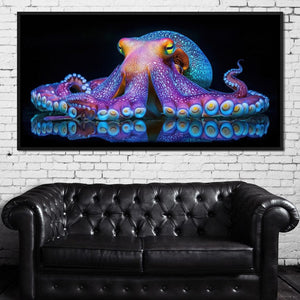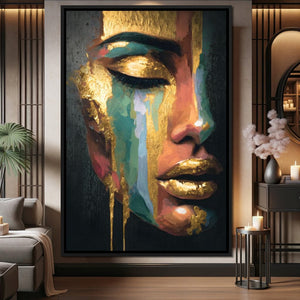
A big, bare wall is a good problem to have. The hard part is not finding something to hang; it is choosing a format that suits the shape of the wall and the furniture in front of it. These large wall art ideas cover six layouts, match them to the walls that tend to cause trouble (above a sofa or bed, a hallway, a stairwell, a double-height wall, an open-plan room) and explain how to choose a subject that still works several feet wide.
Measure first, then pick a format
On a big wall, proportion matters more than taste, so start with two numbers: the width of the wall and the width of any furniture against it.
The short version of the sizing math: art over furniture should span about two-thirds of the furniture's width, and art on a bare wall should fill roughly 60 to 80 percent of the wall's width. On a long wall, that second number often comes out wider than one canvas, which is where sets and arrangements come in. Our guide Is your artwork too small for your wall? goes through the numbers in more detail.
Before ordering, cut kraft paper to the size you are considering and tape it up for a day. A rectangle that looks huge on a screen often looks modest on a long wall.
Six large wall art ideas and where each one works
1. One oversized canvas
A single large canvas gives the room one clear focal point, and there is only one piece to level. It suits walls with an obvious center, such as behind a sofa, a bed or a fireplace.
Choose the orientation from the wall: horizontal above low, wide furniture, vertical on a narrow wall between doors or windows. A black or white floating frame gives an oversized canvas a crisp outline that reads well from across a big room.
2. A 5-piece set
A 5-piece set splits one image across five canvases, stepped so the center panel is tallest and the outer panels are shortest. The gaps add rhythm, and the set covers a lot of width for its height, which suits long living room walls, the wall behind a sectional and the main wall of a dining room.
For example, Gilded Peaks Beyond The Clouds comes as a single canvas up to 60x30 inches and as a 5-piece set in 60x32 or 80x40 inches, so the set is how you take that design past 60 inches wide. Our 5-piece sets are made in gallery wrap; the floating frames are offered on single canvases. Browse more in the five panels collection.

3. A row of three
Three canvases side by side, often called a triptych, are a classic choice above a king bed, a long console or a dining table. You can build one from three single canvases of the same size and orientation: three related landscapes, three abstracts in one palette or three black and white photographs. Keep the gaps equal, about 2 to 3 inches, and measure the whole row, gaps included, against the two-thirds rule. Above a 76-inch-wide king bed, that means a row about 50 inches wide.
4. A grid
Four, six or nine same-size canvases in straight rows and columns read as one calm, architectural block. Grids suit squarish walls, home offices and landings, and they work best with a series: botanicals, cityscapes or black and white photography. The black and white collection is a good place to start: when every image in a grid is black and white, different subjects read as one set.
5. A gallery wall
A gallery wall mixes sizes and orientations around one larger anchor piece. It is the most personal option and the most forgiving on awkward walls broken up by doors or light switches. Family photos printed as a custom photo canvas sit comfortably next to artwork if one or two colors repeat across the arrangement. For layout methods, follow our step-by-step gallery wall guide.
6. A panoramic piece
A panoramic canvas is about twice as wide as it is tall, so it fits where there is plenty of width but limited height: above a bed with a tall headboard, in a room with a low ceiling, or along a hallway. For example, Zebra Herd in Black & White comes in sizes up to 60x30 inches; at 60 inches wide, it is about two-thirds of a 90-inch sofa.

How to decorate a large wall in five tricky spots
Above a sofa or bed
One oversized horizontal canvas, a panoramic piece or a 5-piece set all work here. Center the art on the furniture rather than the wall, keep it to about two-thirds of the furniture's width, and leave roughly 8 to 10 inches between the top of the sofa back or headboard and the bottom of the art. Hung much higher, the art stops belonging to the furniture.
A long hallway
You see hallway art from close range, often at an angle as you walk past, so detail pays off here. A panoramic piece or a row of same-size canvases follows the length of the wall. Maps are a smart choice: a large piece from the world maps collection gives people something to stop and read. Keep every center at the same height, around 57 to 60 inches from the floor.
A stairwell
Stairwell walls are tall and slanted, so a gallery wall or a row of same-size canvases that steps up with the stairs is the usual answer. Keep the center line of the arrangement parallel to the handrail, with each piece centered about 57 to 60 inches above the step directly below it. On a landing, a single tall canvas works well: Golden Meteors Over Silent Lake, for example, comes in a vertical format up to 40x60 inches.

A double-height wall
On a two-story wall, art that seemed large in the planning often looks small, so go bigger than feels comfortable. If furniture sits against the wall, hang the art in relation to it, not centered on the full height: a 5-piece set in its larger size, or a wide grid, fills the zone people actually look at. To use the height instead, stack a grid two or three rows high. Our article on decorating ideas for high walls covers paint, pattern and furniture for these rooms.
An open-plan room
In an open layout, art can mark where one zone ends and the next begins. Give each zone one main piece, such as a large canvas over the sofa and a set over the dining table, and tie them together with a shared color rather than matching subjects: the deep blue of the living room canvas, for instance, repeated as an accent in the dining room art. Avoid two big pieces that land in the same glance and compete.
Pick a subject that holds up at scale
What reads at arm's length does not always read from the doorway. A few things help a subject work as large wall art:
- A clear structure. A strong horizon, a single subject or one bold shape reads from across the room. Busy images with many small elements blur into texture at a distance.
- Visible contrast. Clearly separated light and dark areas hold up at a distance better than subtle tonal shifts.
- Colors already in the room. A large canvas becomes one of the biggest blocks of color in the space, so pull one or two colors from the sofa, rug or cushions. Black and white sidesteps the question.
- A mood that fits. Calm landscapes and soft abstracts suit bedrooms; bolder color and movement can carry a living or dining room.
Landscapes suit wide walls because their horizontal lines echo the wall's shape, and the landscape collection includes several panoramic designs. Abstracts scale well because no single detail has to stay sharp; browse abstract art for color and movement.
Hanging a large piece
Every NicheCanvas piece is made to order and arrives ready to hang, with the hardware already installed. For big pieces:
- Use studs where you can, or wall anchors rated well above the weight of the piece.
- For a set or a grid, hang the center piece first and work outward, checking each gap with a tape measure and each panel with a level. On a 5-piece set, every panel's center sits on the same horizontal line.
FAQ
How big should art be on a large wall?
Over furniture, about two-thirds of the furniture's width: above an 84-inch sofa, that is art about 56 inches wide. On a bare wall, aim for roughly 60 to 80 percent of the wall's width.
How far apart should canvases in a grid or row hang?
About 2 to 3 inches, the same in every direction. A 5-piece set hangs tighter, at 1 to 2 inches, so the image still reads as one picture.
Can I turn my own photo into a large canvas?
Yes. The landscape version of our custom photo canvas, for example, comes in sizes up to 48x36 inches, in gallery wrap or a black or white floating frame. Start from the original full-resolution file, not a screenshot or a copy sent through a messaging app.